The short answer
Tipping in Greece is optional. Locals round up and leave the coins from their change. In tavernas and restaurants, 5-10% is a generous tip for good service; at cafes and in taxis, round up to the next euro. Porters get about €1-2 per bag and housekeeping €1-2 per night. If the bill shows a service charge, you do not need to add more.
The short version
Tipping in Greece is voluntary. Nobody will chase you down the street for leaving nothing, and a server will not add a tip to your bill without asking. What Greeks actually do is smaller and quieter than most visitors expect: they round up, leave the coins from the change, or add a few euros when the meal and the service were good.
For a sit-down meal, 5-10% is a generous, normal tip. For coffee, a drink or a taxi ride, rounding up to the next euro is enough. Anything above that is a thank-you for service that stood out, and it is received that way.
Tavernas and restaurants
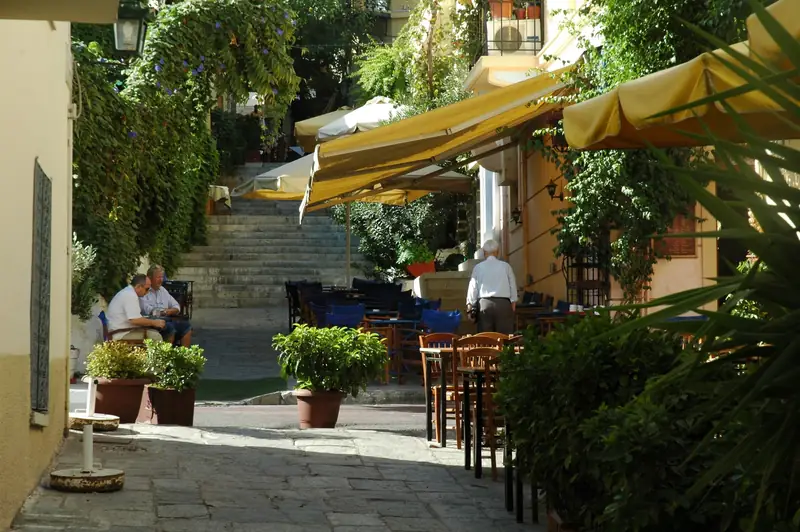
At a neighborhood taverna, the usual move is to round the bill up. A €27 bill becomes €30. A €46 bill becomes €50. If the table was large or the staff went out of their way (splitting dishes, bringing extra bread for the kids, sorting out an allergy), add a little more.
At a more formal restaurant with tablecloths, a wine list and courses, 10% is the comfortable figure. Above 15% is unusual unless something went far beyond the normal.
Read the menu and the bill first
Greek consumer rules require restaurants to post a price list at the entrance and show final prices that include VAT. Menus also have to carry a line that many visitors photograph without knowing what it says. In translation, it reads:
The consumer is not obliged to pay if they do not receive the legal receipt (receipt or invoice).
Two practical points follow from the same rules. First, a restaurant may not bill a generic cover charge for the table setting. Second, items such as bread or bottled water should not be served and charged without your agreement. In practice, a basket of bread often arrives on its own and appears on the bill as a small per-person charge. If you do not want it, say so when it reaches the table. If you eat it, expect to pay for it.
If you see a service charge printed on the bill, that is the tip. You do not need to add another one on top.
The coin-on-the-table habit
When the bill comes on a small tray or in a folder, Greeks usually pay, wait for the change and leave some of the coins behind on the tray. That is the whole ritual. You can also hand over a note and say "keep the change" (in Greek, krata ta resta), which every server understands.
At cafes, the same habit applies on a smaller scale. If a coffee comes to €3.60 and you pay with a €5 note, leaving the 40 cents is plenty, or about a euro if you sat for a long time. At a bar, round up each round or leave a couple of euros at the end of the night. Tip jars at bakeries and kiosks are optional.
Card terminals and tipping
Most places in Athens take cards. Some terminals show a tip screen before you enter your PIN. You can skip it.
A tip added by card is recorded by the business and passed to staff through payroll, where it is subject to Greek tax rules. Cash coins go straight into the server's hand. If you want your few euros to reach the person who looked after you, the simple option is to pay the bill by card and leave the tip in cash. Keep a handful of €1 and €2 coins in your pocket for exactly this reason.
Taxis
Greek taxi drivers are not owed a tip. Most passengers round up the meter to the next euro, and add €1-2 if the driver loaded heavy bags or waited while you found the right entrance.
Every licensed taxi in Greece must carry a card terminal and display a sticker on the rear right window, in Greek and English, saying you can pay by card. The driver must also give you a receipt. If a driver claims the machine is broken, you are within your rights to insist.
From the airport to central Athens there is a legal flat fare, so there is nothing to round up on the meter. A small tip for luggage help is still a kind gesture, never an obligation.
Hotels
- Porters: about €1-2 per bag in a city hotel. On islands with steep steps and no road to the door, where someone carries your suitcase up a cliff path, more is fair.
- Housekeeping: €1-2 per night, left on the pillow or desk with a note, or a single amount at the end of the stay.
- Family-run guesthouses: tipping the owners is not expected. A warm note in the guestbook or a box of sweets is a nice way to say thanks.
- Concierge: hand it to the person directly if they booked a hard-to-get table or solved a real problem.
Guides, boats and tours
Licensed guides at the Acropolis and other sites usually receive €5-10 per person for a half-day tour and €10-20 per person for a full day, when you enjoyed it. "Free" walking tours depend on tips, so budget for one.
Islands versus Athens
The rules do not change when you take the ferry. What changes is the setting. In hotels on hilly islands such as Santorini, porters who haul bags up steps commonly receive €5-10. In a quiet village taverna on a smaller island, a family serving its own food will often refuse anything beyond rounding up, and pushing money on them can feel awkward.
In Athens, the same round-up habit applies in a busy Plaka taverna and in a quiet place in a residential neighborhood. The tip stays your choice.
Getting from Athens airport to the city
Athens International Airport sits in the Mesogeia plain east of the city. You have several real options, and for many travelers public transport is the right one.
| Option | Price | Time to center | Makes sense when |
|---|---|---|---|
| Metro line 3 | €9 one way, €16 return | about 40 min to Syntagma | You land in daytime with light bags and stay near a metro stop |
| X95 express bus | €5.50 | about an hour, longer in traffic | You are on a tight budget or arrive in the middle of the night (it runs 24 hours) |
| Suburban railway | €9 (metro airport ticket valid) | slower, runs to Larissa station and Piraeus | You are heading straight to the port or the main train station |
| Official taxi | €50 flat by day, €65 from midnight to 05:00 | depends on traffic | You want door to door and can queue at the rank |
| Pre-booked private transfer | from €50 per car | depends on traffic | Late arrival, kids, lots of luggage or a group |
The metro is the easy pick for most people. Airport trains run from early morning until around midnight and are less frequent than city trains, so check the departure board. During track works on line 3 in 2026, some late-evening trains have run only as far as Ethniki Amyna, so look at STASY notices before a late flight. Standard 90-minute and day tickets are not valid on the airport section. If you stay three days, the €20 three-day tourist ticket includes one round trip to the airport by metro or express bus, plus unlimited city travel.
The X95 stops at Syntagma Square and runs all night, which makes it the cheapest late option. The airport taxi flat fare rose on 18 September 2026, from €40 to €50 by day and from €55 to €65 at night. Confirm the flat fare with the driver before you set off.
If you land late, travel with small children or have more bags than hands, a fixed-price pickup removes the queue and the guesswork. ShuttleHero runs Athens airport transfers from €50 per car for 1-3 passengers, paid by card in advance; the driver waits in arrivals with a name sign, tracks your flight and includes 60 minutes of free waiting after you actually land, and you get a full refund if you cancel at least 24 hours before pickup. A van for 4-8 people is available for groups.
This guide contains one link (marked partner) to ShuttleHero, a private airport transfer service run by the same small team as Two Tickets Abroad. If you book through it, the booking goes to our own company. Full disclosure.
Questions people ask
Is it rude not to tip in Greece?
No. Tipping is voluntary and servers do not expect visitors to follow a fixed percentage. Rounding up or leaving the coins from your change is what most Greeks do. Leaving nothing after poor service is acceptable and will not cause a scene.
How much should I tip at a taverna in Greece?
Round the bill up to a tidy figure, which usually works out at 5-10%. For example, €27 becomes €30. At a formal restaurant, about 10% is normal for good service. If a service charge is printed on the bill, you do not need to add anything.
Can I tip by card in Greece?
Yes. Some card terminals show a tip screen. Card tips are recorded by the business and paid to staff through payroll. If you want the money to go straight to your server, pay the bill by card and leave the tip in coins.
Do I have to pay for bread I did not order in Greece?
Greek consumer rules say items like bread or bottled water should not be served and charged without your agreement. In practice bread often arrives automatically. Say you do not want it when it reaches the table; if you eat it, expect it on the bill.
Do you tip taxi drivers in Athens?
It is not expected. Most people round up the meter to the next euro and add €1-2 for help with heavy bags. Taxis must accept cards and issue a receipt. The airport to center flat fare is €50 by day and €65 from midnight to 05:00.
Is tipping different on the Greek islands?
The custom is the same: voluntary, small and usually in cash. On hilly islands such as Santorini, porters who carry bags up steps commonly receive €5-10. Small family tavernas often expect nothing beyond rounding up.
Sources we checked
- OASA: Prices of Products (Athens public transport fares)
- Naftemporiki: Athens airport taxi flat fare rises to €50 / €65
- Dnews: new taxi fares in force, FEK B' 5674/18.09.2026
- Naftemporiki: EKPOIZO consumer rights in restaurants (cover charge, bread, receipts)
- To Vima: Taxis in Greece must display card payment option
- CNN Greece: when card tips are subject to tax and contributions
- To Vima: Athens Metro line 3 night closures for rail works
- Athens Transport: airport connections (metro, X95, suburban rail)
- Greek City Times: tipping etiquette in Greece
- Chasing the Donkey: tipping in Greece