The short answer
Most German shops close on Sundays and public holidays; in Berlin, station, airport and petrol station shops stay open. Night quiet hours run from 22:00 to 6:00, and Sundays are quiet all day. Drinks carry a Pfand deposit: €0.25 on single-use bottles and cans, usually €0.15 on reusable bottles and €0.08 on beer bottles, refunded at supermarket machines.
Sunday really is a day off
The first surprise for many visitors to Germany comes on a Sunday morning: the supermarket is dark, the drugstore is shuttered, and the clothing shops on the main street have their grilles down. This is the law. Shop opening hours (Ladenöffnung, older Germans still say Ladenschluss) are set by each federal state, and every state keeps Sundays and public holidays largely closed for retail.
Berlin is one of the more relaxed states. Shops there may open around the clock from Monday to Saturday, and many supermarkets run until 22:00 or midnight. On Sundays and holidays, though, most shops must stay shut. The exceptions are specific:
- Shops in main train stations, airports and bus terminals may open on Sundays.
- Petrol stations and pharmacies may open, with pharmacies on a rotating emergency schedule.
- Bakeries, flower shops and newsagents selling only those goods may open from 7:00 to 16:00.
- Souvenir and tourist shops selling maps, guidebooks and similar items may open from 13:00 to 20:00.
Berlin also allows a handful of shopping Sundays each year, when shops may open from 13:00 to 20:00. The remaining dates in 2026 are 6 December and 20 December, tied to the Christmas markets.
The practical fix: shop on Saturday, or go to the station
If you arrive on a Saturday night or plan a Sunday picnic, buy groceries on Saturday. If you forget, head for a big station. Berlin Hauptbahnhof, Friedrichstraße and Ostbahnhof have supermarkets and bakeries that trade on Sundays, which is why their aisles are packed on Sunday afternoons. Restaurants, cafés, museums and bars all open normally on Sundays, so the city does not stop. Only the shops do.
Spätis: Berlin's corner shops, with a Sunday catch
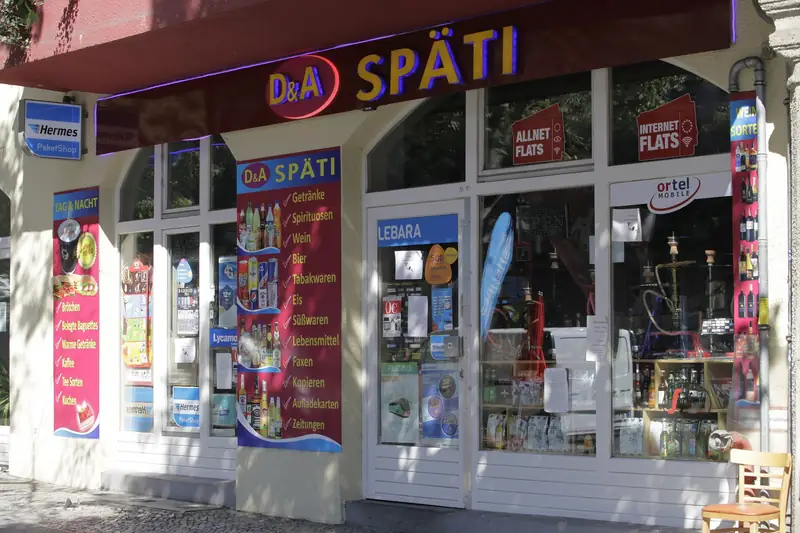
A Späti (short for Spätkauf, late shop) is a small kiosk selling cold beer, soft drinks, snacks, cigarettes and phone top-up cards, often with a bench outside. They are part of Berlin street life and stay open late on weekdays and Saturdays.
Sunday is the gray area. Under current Berlin law, Spätis are generally not allowed to open on Sundays, and a Berlin court confirmed this in 2019. Enforcement varies by district, and some shops register as tourist shops or snack bars to trade legally. The result is that some Spätis are open on Sunday and others are not, and a Späti association has announced plans for a referendum to change the rules. Do not count on one being open.
Quiet hours: Ruhezeit
Germans take quiet time seriously, and it is written into law. Berlin's state noise law bans noise that could disturb other people's night rest from 22:00 to 6:00, and bans noise that seriously disturbs people's rest on Sundays and public holidays. Other states have similar rules. Many apartment buildings add their own house rules (Hausordnung), sometimes with a midday quiet period.
For visitors staying in an apartment, this means:
- Keep music and voices down after 22:00, especially on balconies and in stairwells.
- Avoid drilling, hammering or loud vacuuming on Sundays.
- Do not drop bottles into glass containers late at night. Many containers carry a sign with permitted hours.
Neighbors will often say something directly if you are too loud, and a quick apology settles it.
Pfand: the bottle deposit you pay at the till
Look closely at a German receipt and you will see a small extra charge next to your drinks. That is Pfand, a deposit refunded when you return the empty container. The amounts, according to the German consumer advice centers (Verbraucherzentrale):
| Container | Deposit |
|---|---|
| Single-use plastic bottles and cans (0.1 to 3 liters) | €0.25 |
| Reusable plastic or glass bottles (most drinks) | Usually €0.15 |
| Reusable beer bottles | €0.08 |
| Swing-top and special bottles | Can be more |
How to get your money back
Almost every supermarket has a reverse vending machine (Pfandautomat) near the entrance. Feed in bottles and cans one at a time, label side visible. When you finish, press the button and the machine prints a voucher (Pfandbon). Hand it in at the checkout and the amount comes off your shopping or is paid out in cash.
Shops that sell single-use drinks must take back single-use containers of the same material, even if you bought them elsewhere. Reusable bottles are different: a shop may refuse them if it does not sell that type. Crushed cans and bottles often get rejected by the machine, so keep them intact.
A small local custom: if you do not want to bother, leave empty bottles standing next to a public bin, not inside it. People who collect deposits for income can then take them without digging through trash.
Cash is still common
Germany has been slow to give up cash. In the Bundesbank's 2025 payment behavior study, cash was used for 45% of purchases. That was the first time card and digital payments passed half, and it still makes cash the single most used payment method. Cards are accepted in supermarkets, chains and most restaurants in Berlin, but small bakeries, Spätis, market stalls, some bars and older family restaurants may still be cash only or have a card minimum.
Carry €20-40 in cash for small purchases. In restaurants, tipping is usually done by rounding up or telling the server the total you want to pay, for example saying "30, bitte" on a bill of €27.40.
Wait for the green man
Crossing on a red pedestrian light is something many Germans will not do, even on an empty street at night. It is an offense with a fine of about €5, rising to €10 if you endanger someone or cause an accident. The fine is small. The social pressure is real, especially if children are waiting at the same crossing, because adults are expected to set an example. You will also notice that cycle lanes are often marked on the sidewalk in red or a different paving. Do not walk in them.
Recycling bins and what goes where
Berlin sorts household waste into separate streams, and apartment rentals will have several bins in the courtyard:
- Yellow (or orange) bin: plastic packaging, metal cans, cartons.
- Blue bin: paper and cardboard.
- Brown bin: food scraps and organic waste.
- Gray or black bin: everything else (residual waste).
- Glass: into street containers sorted by color: white, brown and green.
Deposit bottles do not go in any of these. Return them for the Pfand instead.
Getting from Berlin Brandenburg Airport into the city
Berlin Brandenburg Airport (BER) is about 25 km southeast of the center. Every train and S-Bahn from the airport needs a single ticket for zones ABC, €5.00 in 2026. Paper tickets must be validated before you board.
FEX Airport Express. Since the December 2025 timetable change, the FEX runs every 15 minutes via Südkreuz (14 minutes) and Potsdamer Platz (19 minutes) to Berlin Hauptbahnhof in about 23 minutes. The hourly RE20 uses the same fast route. Older guides mention the RE8, which no longer runs directly to the airport.
S-Bahn. The S9 runs every 20 minutes to Ostkreuz, Alexanderplatz and Friedrichstraße, taking about 40 minutes to Alexanderplatz. The S85 serves Ostkreuz. Regional RB24 and RB32 trains reach Ostkreuz in about 20 minutes. For most visitors, rail is the best way into Berlin.
Buses. X7 and X71 express buses connect the airport with U-Bahn Rudow, the end of the U7 line. This suits you if you are staying in Neukölln or along the U7.
Taxi. Berlin taxis run on the meter: €4.30 to start plus €2.10 to €2.80 per kilometer. To central Berlin that works out at about €55-70, depending on your address and traffic. Use the official taxi rank outside arrivals.
| Option | Price | Time to center | Makes sense when |
|---|---|---|---|
| FEX Airport Express | €5.00 (ABC ticket) | About 23 min to Hauptbahnhof | Staying near Hbf, Potsdamer Platz or Südkreuz |
| S-Bahn S9 | €5.00 (ABC ticket) | About 40 min to Alexanderplatz | Staying in the east or around Alexanderplatz |
| Bus X7/X71 + U7 | €5.00 (ABC ticket) | About 65 min to western Berlin | Staying near the U7 line |
| Taxi (metered) | About €55-70 | Depends on traffic | Up to four people, door to door |
| Pre-booked private transfer | From €75 per car (1-3 people) | Depends on traffic | Late arrival, kids, heavy luggage, groups |
If you land late, travel with children, or carry more luggage than you want on a crowded train, a pre-booked ShuttleHero transfer from BER costs from €75 per vehicle for one to three passengers, paid by card in advance. Your driver tracks the flight, waits in arrivals with a name sign and includes 60 minutes of free waiting after landing. Vans for four to eight people are available, and cancellations at least 24 hours before pickup get a full refund.
And if you land on a Saturday evening, buy what you need for Sunday breakfast before you leave the airport. The shops at BER are allowed to stay open.
This guide contains one link (marked partner) to ShuttleHero, a private airport transfer service run by the same small team as Two Tickets Abroad. If you book through it, the booking goes to our own company. Full disclosure.
Questions people ask
Are shops open on Sundays in Berlin?
Most are not. Berlin law keeps shops closed on Sundays and public holidays, with exceptions for shops in main train stations, airports and bus terminals, petrol stations, pharmacies, and bakeries or flower shops from 7:00 to 16:00. Restaurants, cafés and museums open normally.
How much is the bottle deposit in Germany?
Single-use plastic bottles and cans carry €0.25 Pfand. Reusable bottles are usually €0.15, and reusable beer bottles €0.08. Return them at a supermarket machine, take the printed voucher to the checkout, and the amount is deducted or paid out.
Can you return bottles at any supermarket in Germany?
Single-use bottles and cans can be returned at any shop that sells single-use containers of the same material, even if you bought them elsewhere. Reusable bottles can be refused if the shop does not sell that type.
What are quiet hours in Germany?
In Berlin, the state noise law protects night rest from 22:00 to 6:00 and bans seriously disturbing noise on Sundays and public holidays. Other states have similar rules, and many apartment buildings add their own house rules.
Do you need cash in Germany?
It helps. In the Bundesbank's 2025 study, 45% of purchases were still paid in cash. Supermarkets and most restaurants take cards, but small bakeries, Spätis, market stalls and some bars may be cash only. Carry €20-40 for small purchases.
How do you get from BER airport to central Berlin?
Buy a €5.00 ABC single ticket. The FEX Airport Express reaches Hauptbahnhof in about 23 minutes every 15 minutes, and the S9 reaches Alexanderplatz in about 40 minutes. A metered taxi costs about €55-70 to central Berlin.
Sources we checked
- IHK Berlin: Ladenöffnungszeiten in Berlin
- Verbraucherzentrale: Fragen und Antworten zum Einwegpfand und Dosenpfand
- Verbraucherzentrale: Mehrweg oder Einweg, Unterschiede beim Pfand
- Deutsche Bundesbank: Zahlungsverhalten in Deutschland 2025
- VBB: Mit den Öffis zum Flughafen BER
- visitBerlin: Taxis in Berlin
- Landes-Immissionsschutzgesetz Berlin, §§ 3 and 4 (umwelt-online)
- Berliner Kurier: Spätis am Sonntag, Ordnungsämter entscheiden unterschiedlich
- Bezirksamt Mitte: Fit in Sachen Müll
- web.de: Verkehrsregeln für Fußgänger, wann ein Bußgeld droht