The short answer
Say "Bonjour, madame" or "Bonjour, monsieur" every time you enter a shop or café, and "Merci, au revoir" when you leave. Service is already included in French menu prices, so tipping is just small change or 5-10% for great service. Tap water is free with a meal, the bill comes only when you ask, and coffee at the counter costs less than on the terrace.
The one word that sets the tone: bonjour
In Paris, a shop or café is treated a bit like someone's front room. You walk in, you greet the person behind the counter, and only then do you ask for something. A plain "Bonjour, madame" or "Bonjour, monsieur" as you step through the door is the expected opening. After about 6 pm, switch to "Bonsoir".
Skipping the greeting and going straight to "Do you have this in a medium?" reads as rude, even if your tone is friendly. Many visitors who say Parisians were cold to them simply missed this first step. The fix costs one word, and it works in bakeries, pharmacies, tabacs, boutiques and small museums alike.
The same goes for leaving. A quick "Merci, au revoir" or "Bonne journée" (have a good day) closes the exchange. In the evening it becomes "Bonne soirée".
Madame, monsieur, and what not to call a waiter
Adding madame or monsieur after bonjour is normal and polite at any age. You do not need a surname. To get a server's attention, make eye contact and say "S'il vous plaît, monsieur" or "S'il vous plaît, madame". Calling out "Garçon!" belongs in old films. Today it sounds dismissive, so leave it there.
If your French stops at bonjour, that is fine. Open in French, then ask "Parlez-vous anglais?" Most people in central Paris will switch happily once the greeting has been made.
How a Paris café works
Counter, inside or terrace: three prices for the same coffee
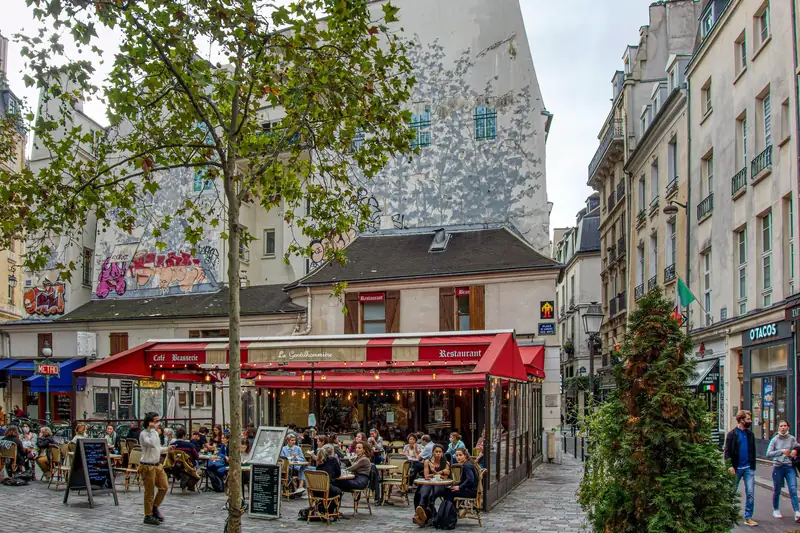
A café can legally charge different prices depending on where you drink. An espresso standing at the bar (au comptoir) is usually the cheapest. The same cup at a table inside (en salle) costs a little more, and a seat on the terrace (en terrasse) often costs the most. French consumer rules require cafés to display these prices, including service, so look for the price board near the bar or by the door.
Standing at the counter is a perfectly respectable way to have a morning coffee, and plenty of locals do exactly that. If you want to sit and watch the street for an hour, the terrace price is what you pay for the seat.
Ordering coffee
Ask for "un café" and you get an espresso. A café crème is the closest thing to a large milky coffee, and a noisette is an espresso with a dash of milk. Cappuccinos exist in most places, but milky coffee is mainly a morning drink here.
Water, service and tipping
Tap water is free with a meal
In a sit-down restaurant you can ask for "une carafe d'eau, s'il vous plaît" and you get a jug of tap water at no charge. French price rules treat ordinary water as part of the meal, alongside bread. If you simply say "water", you may be offered a bottle of mineral or sparkling water, which does go on the bill. Paris tap water is safe to drink.
The rule is tied to food. Popping into a bar and asking only for a glass of tap water, with no other order, is a different situation, so order something first.
Service is already in the price
French rules require restaurants and cafés to show prices service compris, meaning service is already included in every price on the menu. The restaurant sets the service percentage itself, and 15% is a common figure. You will not see a separate service line added at the end, and you are not expected to calculate a tip on top the way you would in the United States.
So do you tip at all?
A small extra is a thank you, not an obligation. Common practice:
- Coffee or a drink at the bar: leave the small change, or round up to the next euro.
- A casual meal: a euro or two per person if the service was good.
- A long dinner with attentive service: about 5-10% is generous by local standards.
Card machines in France often have no tip option. If you want to tip, leave coins on the table or the small dish the bill came on.
The bill only comes when you ask
A Paris waiter will rarely bring the check before you request it. Rushing you out would be considered bad service, so you can sit over an empty cup for a long time without anyone hovering. When you are ready, catch the server's eye and say "L'addition, s'il vous plaît". Some people make a small writing gesture in the air, which is widely understood.
At busy lunchtime spots, payment may happen at the table with a portable card machine or at the till by the bar. Either is normal.
Timing: lunch, dinner and closed kitchens
Restaurant kitchens in Paris generally serve lunch from about 12:00 to 14:00 and dinner from about 19:30, with last orders often around 21:30 or 22:00. Arrive at 15:00 hoping for a full meal in a traditional bistro and you may find the kitchen closed until evening.
Brasseries are the exception. Many, especially in busy districts, serve continuously from breakfast until late, which makes them the safe option after a long flight or an afternoon museum visit. Cafés will usually sell drinks all day, and many offer simple food like a croque-monsieur outside meal hours.
Lunch is the better deal. A formule or menu du jour (a fixed set of two or three courses) is common at midday and usually cheaper than ordering the same dishes at dinner.
Sundays: what opens and what doesn't
Sunday is still a quiet day for much of Paris retail. French labor law lets food shops (bakeries, butchers, small grocers) open on Sunday morning until 13:00, so plan your picnic supplies early. Many independent shops close all day, and some restaurants close on Sunday evening or Monday.
Areas classed as international tourist zones are different. In zones such as the Champs-Élysées, Le Marais, Les Halles, Saint-Germain and Montmartre, shops are allowed to open every Sunday and later in the evening. Department stores on Boulevard Haussmann also fall inside one of these zones. Museums, cafés and markets keep Sunday busy, so the city never feels shut, but check opening hours for any specific shop before you cross town.
La bise is for friends, not for strangers
The cheek kiss, la bise, is a greeting between friends, family and people who are introduced socially. It is not used with shop staff, waiters, hotel receptionists or people you meet on a business footing. A handshake or simply a spoken greeting is the norm there. If a French friend introduces you at a dinner, follow their lead: they will lean in if a bise is expected. The number of kisses varies by region, and Parisians typically give two.
Getting from Charles de Gaulle Airport into Paris
Paris Charles de Gaulle Airport (CDG) sits about 25 km northeast of the center. Here are the real options in 2026.
RER B. The suburban train runs from the CDG 1 and CDG 2 stations straight through Gare du Nord, Châtelet-Les Halles and Saint-Michel. You need the Paris Région Aéroports ticket at €14 (€7 reduced fare). The ride to Gare du Nord takes roughly 35 minutes, and trains run from about 4:50 to 23:50. It is the cheapest fast option and the right choice for most travelers with light bags. It can be crowded at rush hour, and stations have stairs.
Buses. The Roissybus from Opéra stopped running on 1 March 2026. Its replacement, line 9517, links the airport with Saint-Denis Pleyel, where you change to metro 13 or 14 or the RER D. Expect about 50 minutes or more to central Paris. Paid coach services also run from several Paris stops.
Official taxi. Licensed Paris taxis charge a flat fare of €56 to the Right Bank and €65 to the Left Bank in 2026, for up to four passengers with luggage. A fifth passenger adds €5.50. The flat fare covers addresses inside Paris only, so trips to La Défense or the suburbs run on the meter. Take a taxi only from the official rank outside arrivals.
| Option | Price | Time to center | Makes sense when |
|---|---|---|---|
| RER B train | €14 per person | About 35 min to Gare du Nord | Light bags, daytime, staying near the line |
| Bus 9517 + metro | Regular bus ticket, then metro | About 50-70 min | You are staying near Saint-Denis or line 13/14 |
| Official taxi | €56 Right Bank, €65 Left Bank (flat) | Depends on traffic | Up to four people, address inside Paris |
| Pre-booked private transfer | From €75 per car (1-3 people) | Depends on traffic | Late arrival, kids, heavy luggage, groups |
If you land late, travel with children or car seats, or have more bags than you want to haul through Gare du Nord, a pre-booked ShuttleHero transfer from CDG starts at €75 per vehicle for one to three passengers, paid by card in advance. The driver tracks your flight, waits in arrivals with a name sign, and includes 60 minutes of free waiting after you actually land. Vans for four to eight people are available, and you get a full refund if you cancel at least 24 hours before pickup.
Whichever way you arrive, the first word you say in Paris will probably be to a driver or a ticket agent. Make it bonjour.
This guide contains one link (marked partner) to ShuttleHero, a private airport transfer service run by the same small team as Two Tickets Abroad. If you book through it, the booking goes to our own company. Full disclosure.
Questions people ask
Do you have to say bonjour when entering a shop in Paris?
Yes. Greeting the staff with "Bonjour, madame" or "Bonjour, monsieur" before asking anything is expected in shops, cafés, bakeries and pharmacies. Skipping it comes across as rude. Say "Merci, au revoir" or "Bonne journée" when you leave.
Is service included in Paris restaurant bills?
Yes. French rules require menu prices to be shown service compris, so service is already built into every price. The restaurant sets the percentage, commonly 15%. Any extra tip is optional: small change for a coffee, or about 5-10% for excellent service at dinner.
Is tap water free in Paris restaurants?
Yes, with a meal. Ask for "une carafe d'eau, s'il vous plaît" and you get tap water at no charge. If you just ask for water, you may be offered bottled water, which is charged. Paris tap water is safe to drink.
Why is coffee cheaper at the bar in Paris?
Cafés may set different prices for the counter, the indoor room and the terrace, as long as the prices are displayed. Standing at the bar is usually cheapest. On the terrace you pay a little more for the seat and the view.
Are shops open on Sunday in Paris?
Partly. Food shops may open on Sunday morning until 13:00. In international tourist zones such as the Champs-Élysées, Le Marais, Les Halles and Saint-Germain, shops may open all day every Sunday. Many independent shops elsewhere stay closed.
How much is a taxi from CDG to central Paris in 2026?
Official Paris taxis charge a flat €56 to the Right Bank and €65 to the Left Bank for up to four passengers with luggage. A fifth passenger adds €5.50. The flat fare applies only to addresses inside Paris; La Défense and suburbs are metered.
Sources we checked
- Entreprendre Service-Public: Forfaits taxis 2026 (arrêté du 24 décembre 2025)
- Île-de-France Mobilités: Ticket Paris Région Aéroports
- Île-de-France Mobilités: Travellers, how to get to Île-de-France airports
- Sortir à Paris: RoissyBus is ending, alternatives to Charles de Gaulle
- DGCCRF (economie.gouv.fr): Restaurants, droits et obligations
- DGCCRF (economie.gouv.fr): Cafés et bars, obligations des professionnels
- L'Hôtellerie Restauration: La carafe d'eau doit être gratuite au restaurant
- Ville de Paris: Dérogation au repos dominical (zones touristiques internationales)
- DREETS Normandie: Commerces de détail alimentaire, dimanche jusqu'à 13 heures
- Michelin Guide: Paris restaurant rules and mistakes to avoid