The short answer
Spaniards eat a light breakfast around 8:30-9:00, a snack mid-morning, lunch (the main meal) between about 13:30 and 16:00, and dinner from 20:30, most often 21:00-22:30. Many kitchens close from about 16:00 to 20:00. The weekday menú del día lunch averaged €14.20 nationally in 2025.
The Spanish day, meal by meal
Spain eats on a schedule that runs about two hours behind most of Europe. Once you know the shape of the day, it stops feeling strange. Here is the rhythm you will find in Barcelona and Madrid:
- Desayuno (breakfast), 8:00-9:30. Light and quick: a coffee with a tostada or a pastry. In Catalonia the toast often comes as pan con tomate, bread rubbed with tomato, olive oil and salt. In Madrid, the most common breakfast time is 8:30-9:00.
- Almuerzo or mid-morning snack, around 10:30-12:00. A second, more serious breakfast: a bocadillo (sandwich on a baguette), a slice of tortilla, another coffee. In Barcelona there is a heartier version, the esmorzar de forquilla or "fork breakfast": a hot plate of traditional Catalan food with bread and wine, finished with coffee.
- Comida (lunch), 13:30-16:00. The main meal of the day. Most people sit down around 14:00 or later, and many kitchens take orders until about 16:00.
- Merienda, around 18:00. An afternoon snack, often coffee and something sweet, which keeps people going until dinner.
- Cena (dinner), from 20:30. Restaurants usually start dinner service around 20:30 or 21:00, and the busiest time is roughly 21:00-22:30. On weekends, central areas keep serving past midnight.
A word on vocabulary: in much of Spain almuerzo means the mid-morning snack, while in other places and on some menus it means lunch. The safe word for lunch is comida.
The menú del día: lunch at a fixed price
The best-value meal in Spain is the weekday lunch menu, the menú del día. For one price you usually get a first course (primero), a main (segundo), dessert or coffee, bread, and a drink. The drink is often water, wine, beer or a soft drink. The menu changes daily and is often written on a chalkboard by the door.
The custom has an official origin. In the mid-1960s, Spain's Ministry of Information and Tourism introduced a fixed-price menú turístico with several courses, bread and a drink, with maximum prices set by restaurant category. By 1970 the name had changed to menú del día, and it stuck.
What it costs now: according to the 2025 survey by the hospitality association Hostelería de España with Edenred, the national average was €14.20. Madrid averaged €14.50 and Catalonia €15.40. Expect central Barcelona to sit around or above that figure.
Rules that save confusion:
- It is mostly a weekday lunch offer. Do not expect it at dinner, and many places drop it on weekends.
- Ask "¿Tienen menú del día?" if you do not see a board. Some restaurants hand you only the regular menu unless you ask.
- Choose one dish from each course. Swapping a dessert for coffee is normal.
- Some places charge a supplement for certain dishes on the menu, written next to the dish.
Why everything happens so late
One part of the explanation is the clock. Since 1940, Spain has used Central European Time, the same zone as Berlin and Rome, even though Madrid lies west of Greenwich. The sun rises and sets later on the clock than in London or Lisbon, and meal times followed daylight more than the clock. Long working days with a split lunch break, and plenty of evening heat in summer, did the rest.
You do not need the history to adapt. Move your whole day back by about two hours and the schedule makes sense.
The gap between lunch and dinner
This is where most visitors get caught. Many traditional restaurants close their kitchen after lunch, around 16:00, and do not reopen until 20:00 or 20:30. Walk in hungry at 18:00 and you may find chairs stacked and a polite "la cocina está cerrada" (the kitchen is closed).
Places that do serve in the gap:
- Tapas bars, many of which serve food all afternoon.
- Cafés and bakeries (pastelerías, forns in Catalan) for the merienda.
- Restaurants in the busiest tourist areas, which often run all day.
- Markets with food counters. In Barcelona, La Boqueria and Santa Caterina have bars inside, open during market hours.
Eating dinner at 19:00 is possible, but you will mostly share the room with other visitors. If you want the local atmosphere, book for 21:00 or later.
Tapas customs
Tapas are small plates meant for sharing, and a tapas round is often a warm-up before dinner or a light dinner in itself. A few habits help:
- Order a few plates at a time and add more as you go. Larger portions are raciones; half portions are medias raciones.
- Standing at the bar is normal and often livelier than a table.
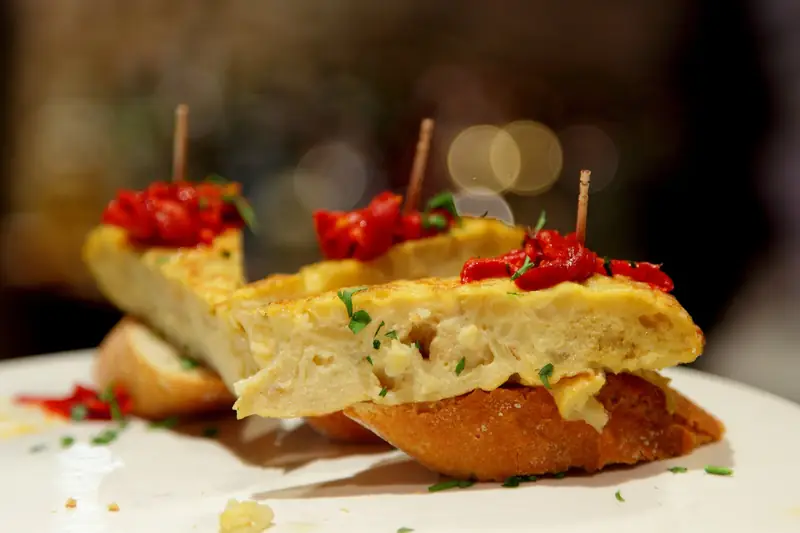
- In Basque-style pintxo bars, common in Barcelona, you may pick pintxos from the counter yourself. Keep the toothpicks: staff often count them to work out your bill.
- In Barcelona, the late-morning or pre-lunch vermut (vermouth with olives, chips or anchovies) is a weekend ritual, especially on Sundays.
Sobremesa: nobody is rushing you
Sobremesa is the time spent talking at the table after the food is finished, with coffee, a digestif, or nothing at all. A weekend lunch can easily run past 17:00 this way.
For visitors, this has one practical effect. Waiters generally will not bring the bill until you ask, because bringing it unasked would look like rushing you. When you are ready, catch someone's eye and say "la cuenta, por favor". In Catalan it is "el compte, si us plau".
Sundays work differently
Sunday is the day for long family lunches, and restaurants in residential areas fill up from about 14:30. Book if you have a place in mind. Many shops are closed, and plenty of family-run restaurants close on Sunday evening, Monday, or both. Check opening hours before you plan a Sunday dinner around a specific address.
A schedule that works for a short trip
- Coffee and toast at a bar around 9:00.
- A snack or second coffee around 11:30.
- Menú del día at 14:00 on weekdays.
- Merienda or a vermut around 18:00.
- Tapas from 20:30, or a dinner booking at 21:00-21:30.
Getting from Barcelona El Prat Airport to the city
Barcelona El Prat Airport (BCN) has two terminals, T1 and T2, and good public transport into town. Your options:
| Option | Price | Time | When it makes sense |
|---|---|---|---|
| Aerobús (A1 from T1, A2 from T2) to Plaça Catalunya | €7.75 single | about 35 min | Hotel near Plaça Espanya, Universitat or Plaça Catalunya; runs 24 hours |
| R2 Nord train (from T2 only) | €2.90 single ticket, or one T-casual trip | about 20 min to Sants, about 27 min to Passeig de Gràcia | Cheapest option, hotel near Sants or Passeig de Gràcia |
| Metro L9 Sud (T1 and T2) | €5.90 Airport ticket | slower; needs a change of line | Hotels near L1, L3 or L5, or if you hold the Hola Barcelona card |
| Official taxi (metered) | meter plus €4.60 airport supplement; €21 minimum | depends on traffic | 2-4 people, no booking |
| Pre-booked private transfer | from €50 per car | depends on traffic | Late arrivals, children, lots of luggage, groups |
The Aerobús is the simplest choice for most first-time visitors. It runs 24 hours, and the city stops are Plaça Espanya, Gran Via, Plaça Universitat and Plaça Catalunya. The R2 Nord commuter train is the cheapest: it leaves Terminal 2 roughly every 30 minutes from about 5:40 to 23:40. If you land at T1, a free shuttle bus links the terminals. The L9 Sud metro stops at both terminals, but you need the special Airport ticket (€5.90), the standard T-casual does not cover the airport stations, and you change lines at Torrassa (L1), Collblanc (L5) or Zona Universitària (L3) to reach the center.
Taxis are black and yellow and wait at official ranks outside both terminals. They run on the meter: in 2026 the flag fall is €2.80, the rate is €1.35 per km on weekdays and €1.66 per km at night and on weekends and holidays, plus a €4.60 airport supplement. Any ride from the airport costs at least €21, and the final fare depends on traffic, time of day and your exact address.
Public transport is a good choice for most travelers who land during the day with light bags. If your flight lands close to midnight, you are traveling with small children, or you have a group with large suitcases, a fixed price is easier to plan around: ShuttleHero offers El Prat transfers from €50 per car for 1-3 passengers (vans for 4-8), paid by card in advance. The driver tracks your flight, meets you in arrivals with a name sign and allows 60 minutes of free waiting after you actually land, and cancellations at least 24 hours before pickup get a full refund.
This guide contains one link (marked partner) to ShuttleHero, a private airport transfer service run by the same small team as Two Tickets Abroad. If you book through it, the booking goes to our own company. Full disclosure.
Questions people ask
What time do people eat dinner in Spain?
Restaurants usually open for dinner around 20:30 or 21:00, and the busiest time is about 21:00-22:30. On weekends in central Barcelona and Madrid, many places keep serving past midnight. Booking for 19:00 is possible, but you will mostly be eating among other visitors.
What time is lunch in Spain?
Lunch is the main meal and usually runs from about 13:30 to 16:00, with most people sitting down around 14:00 or later. Many kitchens stop taking orders around 16:00 and do not reopen until dinner service.
What is included in a menú del día?
Usually a first course, a main course, dessert or coffee, bread and a drink such as water, wine or beer, all for one price. It is mainly a weekday lunch offer. The national average price was €14.20 in 2025, with Catalonia at €15.40.
Where can I eat in Spain between 16:00 and 20:00?
Tapas bars often serve food through the afternoon, and cafés and bakeries are open for the merienda snack. Restaurants in the busiest tourist areas often run all day. In Barcelona, La Boqueria and Santa Caterina markets have food bars during market hours.
Do I need to ask for the bill in Spain?
Yes. Waiters generally wait for you to ask, because bringing the bill unprompted would feel like rushing you through the sobremesa. Say "la cuenta, por favor", or "el compte, si us plau" in Catalan.
How do I get from Barcelona airport to the city center?
The Aerobús costs €7.75 single and takes about 35 minutes to Plaça Catalunya, running 24 hours. The R2 Nord train from Terminal 2 is cheapest at €2.90. The L9 Sud metro needs a €5.90 Airport ticket. Taxis run on the meter with a €4.60 airport supplement.
Sources we checked
- Hosteltur: Horarios de comida y cena en Madrid
- Forbes España: El menú del día se encarece hasta los 14,2 euros (Hostelería de España and Edenred)
- Xataka: El origen del menú del día, el menú turístico
- Catalan News: Esmorzar de forquilla
- Wikipedia: Time in Spain
- Àrea Metropolitana de Barcelona: Tarifas del taxi
- TMB: Airport ticket
- Turisme de Barcelona: Aerobús tickets
- Turisme de Barcelona: Cómo llegar a Barcelona
- 3Cat: Tarifes del transport públic per al 2026