The short answer
Split uses the euro (since 2023). Walking around the historic center in swimwear or shirtless can cost a €150 fine. Book Jadrolinija ferries online and arrive early in summer. Most beaches are pebble, the tap water is normally safe, and most shops close on Sundays. The airport is in Kaštela, about 20 km out; the shuttle bus costs €10.
Money: Croatia uses the euro
Croatia switched from the kuna to the euro on January 1, 2023, at a fixed rate of 7.53450 kuna per euro. If you have old kuna notes in a drawer at home, they are no longer accepted in shops. Prices on menus, ferry tickets and bus fares are all in euros, so there is nothing to convert if you are coming from another eurozone country.
Cards are widely accepted in Split, but keep some coins and small notes for things like a bus ticket bought from the driver, a beach umbrella or a bakery on a quiet morning.
Diocletian's Palace is a neighborhood
The palace that the Roman emperor Diocletian built around the year 300 is not a fenced-off ruin with a ticket gate. It forms a large part of Split's old town, and people still live inside its walls, though fewer each year as more flats turn into holiday rentals.
That has a few practical consequences. The lanes are public streets, so you can walk in at any hour. Many of the doors you pass are private homes, and the cathedral beside the Peristyle is a working church. Keep your voice down late at night, do not sit on doorsteps that clearly belong to someone, and if you rent a flat inside the walls, expect noise from the cafés below on summer evenings.
Cover up in the old town: there is a fine
Since January 1, 2023, a Split city bylaw has banned walking around the historic center (known as Zone A) in a swimsuit, underwear or nothing at all. The fine is €150. Going shirtless counts. City wardens patrol in summer, and signs around town show what is not allowed.
The same rules fine drinking alcohol in public spaces in Zone A, again €150, with an exception for café and bar terraces. Beaches are not covered by the dress rule, so the simple habit is this: swimwear on the beach, a T-shirt and shorts or a cover-up on the walk back.
Ferries and catamarans to the islands
Split is the main port for the central Dalmatian islands: Brač, Hvar, Šolta, Vis and others. The state company Jadrolinija runs car ferries and passenger catamarans from the harbor, and other private operators run catamarans on some routes too.
- Buy online. Jadrolinija sells tickets on its website and lets you board with the ticket on your phone.
- A ticket is not always a seat. Jadrolinija says that only on some lines does the purchased ticket guarantee departure at the time you chose. On busy car ferries in July and August, arrive early and expect a queue, especially if you are bringing a car.
- Check the timetable for your date. Summer and winter schedules differ, and some catamaran routes run only in the main season.
The ferry port, the main bus station and the train station sit next to each other, a few minutes' walk east of the palace walls. That makes it easy to land, catch the airport shuttle into town and continue straight to an island.
Beaches: bring water shoes
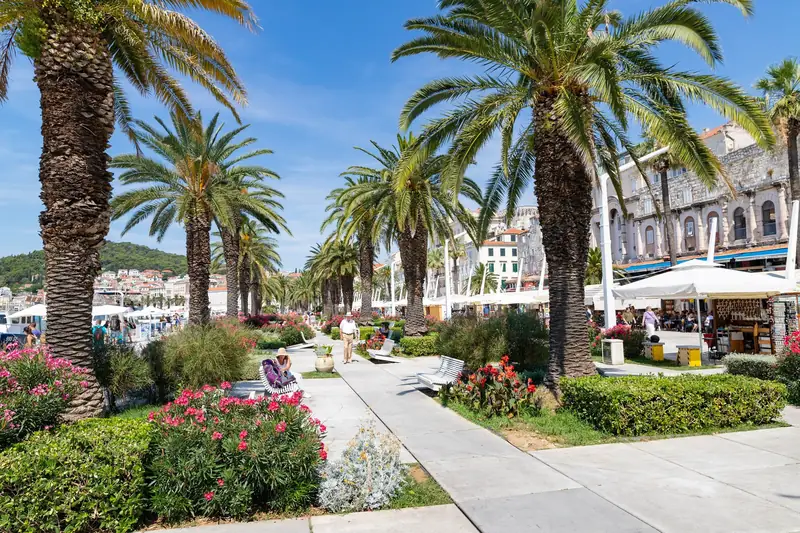
Most beaches on the Dalmatian coast are pebble or rock, and Split follows the pattern. Kašjuni, on the west side of the Marjan peninsula, has small pebbles, and Trstenik to the east is a pebble beach with easy entry into the sea. The well-known exceptions are close to the center: Bačvice is sandy, and it is where locals play picigin, a game of keeping a small ball in the air while standing in the shallows. Firule, just east of Bačvice, has fine sand.
Plastic water shoes cost little in local shops and make rocky entries and sea urchins much less of a worry. A thin mat or a beach chair is also more comfortable on pebbles than a towel alone.
Heat, tap water and the slow afternoon
July and August afternoons in Split regularly reach the low 30s °C, and heat waves push higher. The old town is stone and reflects heat, so plan walking tours for the morning and the evening and save the middle of the day for the sea or the shade. That is also when the town itself slows down.
Split's tap water comes from the Jadro spring and is normally safe to drink. After very heavy rain the spring can turn cloudy. When that happened in January 2026, the water utility said the water stayed chemically and microbiologically safe, while public health officials advised boiling it for small children, older people and anyone with a weak immune system. Outside those notices, refill a bottle from the tap and skip buying plastic.
Sundays and shop hours
Since 2023, Croatian law limits most shops to opening on 16 Sundays a year, and each retailer picks its own Sundays. In practice, a supermarket that is open one Sunday may be closed the next. The government has said it has no plans to change the rule. Cafés and restaurants are not shops and keep their own hours, but if you are arriving on a Sunday with an apartment to stock, buy the basics on Saturday or check the shop's hours first.
The tourist tax
Most overnight guests in Croatia pay a tourist tax per person per night. For Split in 2026 it is reported at about €2.65 per night from April 1 to September 30 and about €1.86 the rest of the year, with children under 12 exempt and ages 12 to 18 paying half. Hotels usually add it as a separate line on the bill. In private apartments it may be included in the price or collected on arrival, so ask your host in writing before you go.
Getting from Split Airport to town
Split Airport (SPU) is not in Split. It sits in Kaštela, toward Trogir, about 20 km from Split and 6 km from Trogir. In summer the road into the city gets heavy traffic, so build in extra time in both directions.
| Option | Price | Time to center | When it makes sense |
|---|---|---|---|
| Airport shuttle bus (Platanus) | €10 one way, €15 return | about 30 min | Most travelers with one suitcase each. Leaves about 30 minutes after each arrival and goes nonstop to the main bus station next to the ferry port. |
| City bus 37 (Promet Split) | €2-4 depending on how you pay | longer, many stops | Light packers on a budget, or if you are staying in Kaštela or Trogir. |
| Taxi from the rank | about €45-55, metered | about 25-30 min | When the shuttle has just left and you want to go now. |
| Pre-booked private transfer | from €50 per car | about 25-30 min | Late arrivals, families, heavy luggage, groups, accommodation away from the bus station. |
The shuttle bus is the default for good reasons. It is the airport's listed shuttle service, it departs from Parking Zone P1 outside arrivals, the ticket includes one suitcase, and the ticket is valid for any departure that day if your flight is late. It drops you at the main bus station, a short walk from the palace and right by the ferries.
Bus 37 is Promet Split's line between Split, the airport and Trogir. A single Split-Kaštela ticket costs €4 bought from the driver and €2 at the lower prepaid rate on the current price list. You can also buy tickets in the Promet Split app. It stops along the coast through Kaštela, so it is slower than the shuttle. Check the Promet Split timetable for the stop closest to where you are staying.
Taxis wait in front of the terminal during airport hours. They run on the meter, so the final price depends on traffic.
If you land late, travel with small children, carry more luggage than a shuttle bus likes, or are a group of four or more, a fixed-price transfer is simpler. ShuttleHero runs Split Airport transfers from €50 per car for 1-3 people, paid by card in advance, with the driver waiting in arrivals with a name sign. They track your flight and include 60 minutes of free waiting after you actually land, and you get a full refund if you cancel at least 24 hours before pickup.
This guide contains one link (marked partner) to ShuttleHero, a private airport transfer service run by the same small team as Two Tickets Abroad. If you book through it, the booking goes to our own company. Full disclosure.
Questions people ask
Do I need cash in Split?
Not much. Croatia has used the euro since January 2023 and cards are widely accepted in Split. Keep a few coins and small notes for a bus ticket bought from the driver, beach rentals or a small bakery. Old kuna notes are no longer accepted in shops.
Can I walk around Split in a bikini or without a shirt?
Not in the historic center. A city bylaw in force since January 2023 bans swimwear, underwear and going shirtless in Zone A, with a €150 fine. Drinking alcohol in public spaces there can bring the same fine, except on café terraces. Beaches are fine; cover up for the walk back.
Do I need to book the ferry to Hvar or Brač in advance?
In July and August, yes, buy online as early as you can. Jadrolinija sells tickets on its website and you board with a mobile ticket, but on some lines a ticket does not guarantee a specific sailing, so arrive early. Catamarans can sell out on busy days.
Is the tap water in Split safe to drink?
Yes, normally. It comes from the Jadro spring. After very heavy rain the spring can turn cloudy; during the January 2026 episode the utility said the water stayed safe, while health officials advised boiling it for small children, older people and those with weak immune systems.
How far is Split Airport from the city?
The airport is in Kaštela, about 20 km from Split and 6 km from Trogir. The airport shuttle bus takes about 30 minutes to the main bus station and costs €10 one way. Allow extra time in summer, when traffic into the city is heavy.
Are shops open on Sunday in Split?
Many are not. Croatian law limits most shops to 16 Sundays a year, and each retailer chooses its own dates. Cafés and restaurants keep their own hours. If you arrive on a Sunday, shop on Saturday or check opening hours before you go.
Sources we checked
- Split Airport: To and from the airport
- Platanus: Split Airport Shuttle (tickets and timetable)
- Promet Split: Price list of tickets (from June 1, 2026)
- Jadrolinija: Sailing schedules and online tickets
- Croatian National Bank: Croatia to introduce the euro on 1 January 2023
- Croatia Week: Wearing a bikini or going shirtless on streets in Split now forbidden
- Bookiscout: Split airport access guide (taxi fare estimate)
- Visit Split: Beaches
- Index.hr: Vodovod i kanalizacija Split on cloudy but safe water (January 2026)
- Croatia Week: Sunday trading law and small retailers (February 2026)